Showing posts with label limitations. Show all posts

Monday, 19 January 2015

Monsters like you've never seen before

I spoke before about how regularly in films and tv series 3D animation is used for environmental expansions to scenes, a lot of the times creatures, animals or monsters will be created as well. Most of the times because the animals in question are too dangerous to really work with, or they just don't exist.

An Oscar winning performance on this the past few years was won by the team that was working on Life of Pi. (Dutch pride yay!) One of the many animals they had to create was this tiger. Usually making creatures isn't that big of a problem, to make them lifelike and have them interact with the actors is the tough part. Because you're working with something that isn't technically there is difficult for actors and the director, the harder part is for the VFX team. They need to work with what they get. There are a lot of things happening. For example, the scene where the tiger escapes from beneath the tarp, the boat is swaying back and forth, in which the water reacts as well. These are two different kind of software in one scene: for the tiger and the water simulation.
Also because you're working with something that isn't there, a lot of things need to be thought out carefully in advance; where will the creature (tiger) be placed in the scene, how is the actor going to react to it, how do we make it look convincing? When interacting "physically" with something that is CGI, actors usually get something like a mock-up or a dummy to hold on to, where the animators then can place their work onto or over.


Another recent film with complex creatures is Hercules (2014). I went to the Double Negative talk at the Bradford Animation Festival, and this gave lots of insight into what's actually happening at the visual effects department. These creatures were made from scratch derived from some digital sculpts they received to work with. The creatures had to look believable while interacting with the actors. A difficult problem that had to be tackled in these sequences: the fur. Fur and hair is a pain in the ass to make look realistic. They created a specific tool for this: Furball, to preview render the fur way faster than was previously possible to create stunning performances of the creatures.


Considering this is all possible opens a lot of doors. You don't necessarily have to work with the real life creatures (if they're just animals, and not like Ceberus, the three headed dog). In a behind the scenes video on this site was said that a sequence with the lion was already finished when they were still actually shooting the film. Having such reference is a lot of help for a director when working and shooting the scene. When working on something and seeing something is already near finished, or finished enough to work way in a sense, sure keeps the team motivated.
What I found really interesting when listening to the talk of Double Negative, is how much thought is put into creating such creatures. They place layers of layers, each with different properties, to make the 3D model react as lifelike as possible. A mesh-layer acting like muscle, another layer sliding on top of it like it's skin, add the fur which reacts in a totally different way, but it's all necessary to make the close up shots look believable. 


Another worthy mention is the dragon Smaug in the Hobbit trilogy. Instead of only creating the dragon and having it animated after the recorded audio of Benedict Cumberbatch, they incorporated motion tracking with it as well. Which sounds quite funny. We know that motion tracking is popular with human like creatures (Davy Jones in Pirates of the Caribbean, Gollum in the Lord of the Rings and the Hobbit respectively) but translating the movements of a human face to that of a dragon sounds a bit strange. They used tons of trackers on Ben's face to record how his muscles are moving when he's acting, using dramatic movements on his eyebrows mouth and nose. Those drastic movements are I guess useful to translate to give a better idea of how the dragon would be moving I guess? 


But it doesn't stop there for Benedict didn't only record his facial expressions to be translated into the face of the dragon, he has also been acting in a motion tracking suit for the bodily movements of the dragon. (literally flailing and crawling over the floor must've been a hilarious sight). 
I think it's amazing how all those recorded movements then can be translated into something that isn't even close to human anatomy. Aside from that, Smaug is a decent piece of 3D imagery as well. He has a detailed texture of scales all over his body, and a very expressive face, which was animated beautifully. Almost as beautiful as Lee Pace as Thranduil.


Sunday, 18 January 2015

EVERYTHING YOU THOUGHT WAS REAL IS FAKE! - Environment expansions.

One of the things in modern technology that takes filmmaking to a whole new level, is how advanced the 3D technology is nowadays. Since the start of 3D generated images, they've been using it to create scenes that are very hard or impossible to film without harming people (sinking of ships, close up explosions, futuristic sequences). Because of 3D animation they can expand the environments that already exist, create entirely new ones, or alter the environment when shot on location.


In a lot of science fiction or fantasy films/tv series, they need to create an environment that is either very surreal or very idyllic. To make the audience feel like they're in the film they're watching, you have to create an environment that really sweeps you off your feet. A lot of the times for series like Game of Thrones, scenes are shot outdoors in open fields or other places. To then make it fit into the idyllic, medieval surroundings the book describes, a lot of environmental properties are added to the scene, castles, forts, walls, or even whole armies and camps. Environmental expansion is useful in a lot of ways, you don't need to hire thousands of extras to represent an army, usually you only need a small number of people, and these will then be "copied" in the computer and thus a whole army will be generated. Because we never see their faces, they only need to move, which is usually done through crowd simulations.  


But I was talking about environments and not crowd simulations. Nowadays a lot of movies are shot in studios, where either a complete base of a set is built where the actors in act and afterwards the extra surroundings get created that have no interaction with the actors. Or they film in front of a green/blue screen with a prop or part of a set where the entirety of the scene will be computer generated. Scenes shot in a green/blue screen studio are shot there for probably two reasons: one; it's too dangerous to do it for real somewhere outside (for example the dangling from a cable off an ice wall, see second GIF at the top, or the hot air balloon basket in the river down below) or two; the environment they need to create is in no way achievable with props. 


Very impossible scenes to shoot from the past century are for example the Pirates of the Caribbean quartet. They used a MASSIVE tank where a ship could fit in to film the scenes that occur on the open sea. Of course they also used scaled down replicas to shoot the film, otherwise it would've probably cost a lot more money than it already did. Environmental expansion/alteration is also used when a film is set in the nearer past, when they need to change the skyline of a city for some buildings didn't exist yet in, for example, the 70's. A good example is probably Rock of Ages. This Rock Opera was filmed a few years ago, but was set in Los Angeles. They've shot scenes on different locations, but still had to alter a lot since it's set in 1987


A lot of people, watchers of films, know of course that a lot of visual effects is involved in modern film industry because it's very often very obvious. But a lot of the time it goes unnoticed because it seems like such a "simple scene to shoot, why would visual effects be involved". People don't seem to realise that a lot of films aren't shot on location anymore, especially because they have a budget that allows them to use computer generated effects.

Speaking of budget, it reminds me of a funny fact. In 2013, they released Oldboy, a recreation of the ten year older film produced in South Korea. With a budget of 3 million dollars, lack of special effects and a filming culture in where they shoot a lot on location, they didn't need a bigger budget than that. It hit box office with 15 million dollars. The 2013 american remake however: packed with action and lots and lots of visual effects called for a budget of 40 million dollars, while making "only" 4.7 million dollars off it in box office. Is budget and special effects everything in a film: apparently, it seems not, but we sure think it's all visually appealing. 

Character diversity

I feel because of the hype around female designs in Tangled, Frozen and even Big Hero 6, a lot of questions pop up regarding diversity in character design. There's been a lot of discussion and controversy regarding Disney recycling their designs (especially in their 3D releases) and thus recreating the same images for their female characters. Girls with big, doe-like eyes, tiny noses and slim lips.

One of the questions that always seem to reach the surface is, Is Disney capable of creating a more diverse collection of designs for their female leads? Capable, yes. Wishing to do so, probably not. Ever since the start of their female leads in animations, the girls have had big, bright eyes and tiny facial features (not all, but a lot). This reoccurring phenomenon gives me the idea this is a trademark for Disney films, for I have seen quite a variety of designs for girls in other films. For example: Fiona and the princesses in Shrek have all quite realistic looking features and proportions, other films from Dreamworks feature a lot of diversity in features of their females as well. Same goes for Pixar, every film calls another style of human characters (when they make an appearance), thus not gathering a same look for them all.

So of course, it is very possible to create a large diversity in designs for 3D animated characters, but I feel we don't see it as often than for 2D animated films. And I wonder why. What I noticed is that the big shots like Disney, Pixar and Dreamworks, play it relative safe when it comes to designing their characters for 3D films, at least safer when they did for 2D films. There are designs in some films that don't fit the "mould" but still feel very realistic. While I get the feeling that "more unknown" (and with that I mean companies not as big branded as the former three, like Sony or Blue Sky) studios play around more with their designs in some instances.


Even though Disney's princesses/female leads "continue to look the same" a lot of the extra characters seem to get a lot more diversity, where in other films I feel they try to distribute the diversity over the whole cast. While in Tangled the mains were all gorgeous (Rapunzel, Flynn, Mother Gothel), the extras (the Thugs) were quite diverse, but in Brave or the Incredibles for example, all the characters have distinctive style. What I'm getting here at is, while a lot of people try and use the excuse: "it's hard to create a lot of diversity in 3D animated characters, so the reason they play it safe is because of that", I beg to differ. There already have been created lots of diverse characters in the past fifteen years, and I feel this is only growing. The reason why a lot of 3D characters will probably still look alike, just like a lot of 2D characters did, is just a creative choice of the directors of a film and not an incapability.

Wednesday, 14 January 2015

Uncanny Valley

Das Unheimliche = The opposite of what is familiar.
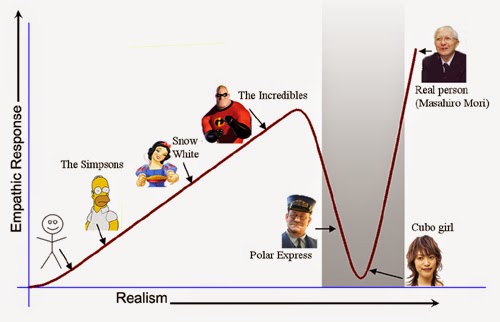
"The uncanny is a Freudian concept of an instance where something can be both familiar yet alien at the same time, resulting in a feeling of its being uncomfortably strange."* Put it simple: something is created to resemble something human, it looks like something human, but there's something off and you can't put your finger on it where exactly it feels wrong. This creates a paradoxical nature where you are simultaneously attracted and repulsed by the thing you're looking at.

The uncanny valley in animation?
The uncanny valley, in animation or in real life, is achieved when they wanted to create something that looks as human as possible, but in fact it looks horribly eery. In real life this is usually achieved with new robots. Robots used to look as inhumane as possible, like machines, up to one point where they decided to create humanoids: robots that have proportions similar to a human body. These robots were created for research of prosthetics, companionship and personal assistance. Even more humanlike robots were then created who have a "skin" that resembles the human skin and face. While they might be produced for the same functions of companionship or assistance, I feel I would rather get help from a more robot looking creature than a human looking creature that isn't quite there yet.

How does animation fit in the uncanny valley?
One of the first names that comes to mind when asking people about animation films where they thought the characters looked eerily weird is the Polar Express. The film experimented with characters that looked as human as possible and the movements recorded through very detailed motion capture suits to create as movements in the film that were as human as possible. While the film has pretty stunning visuals (when it doesn't concern the characters), a lot of critics were horrified by the dead-looking, mannequin-like characters which kind of resembled zombies. I must honestly say I agree. The faces are stiff, the eyes look dead, which is a shame since the bodily movements are gorgeous. 
Another film that gives me a bit of creeps is the Adventures of Tintin. I've never fully seen the feature, but I've watched the intro and some trailers and I'm a bit freaked out. In the beginning I was awestruck with how human it looked, that I couldn't even tell it was animated, but it was all too perfect that I started to dislike the looks. It feels like they used a human body with correct proportions and glued a head on top that is still too character looking to pull it off completely.
To what point is motion capture creepy and when is it good? It is known that motion capture is used in many films and instances, like Gollum and Davy Jones in films, but also in games like Assassin's Creed and Watchdogs. Both Gollum and Davy Jones are inhumane characters with humanlike roots, but are so far distorted from the look which we view as "human", it doesn't look weird and repulsive to us, so why does the combination of human-looking characters in gameplay and motion capture work at least more than it does in before mentioned feature films? I'm note quite sure.


Other instances of 3D animated characters which give me real bad vibes are the "Cubo girl" and Sweety (used to catch online predators.) Cubo girl is a webbrowser that lets the visitor of the webpage interact with this image of a girl. When moving the cursor, the girl follows it with her eyes while slightly turning her head. Because of the way her mouth is shaped, the colour of her eyes and the distortion to the sides of her face as she moves it around, it feels really weird looking at it.
Sweety is a computer generated young girl (created by Dutch people, get yo pride on!), used to catch online predators. They would create animations with commands for the girl which could be used as replies to the men in the chatroom with her. The combination of the human like complexion, the webcam placed at an angle where her face isn't completely visible and the quality of the webcam, it doesn't look like something is off. In fact, it looks awfully lot like a young girl sitting there. However, when I first saw the promotional video, I initially thought I was looking at footage of a real girl, but then it struck me and something was off. That was also the moment in the video in where she reveals she isn't real. I must say it's a gorgeous piece of animation, and there is so much effort put in all the detail, but honestly: there's something about her that puts me off a bit and I can't say why. 

I guess that's why it's the uncanny valley, right?


*Wikipedia, the uncanny http://en.wikipedia.org/wiki/Uncanny, forward source http://www-rohan.sdsu.edu/~amtower/uncanny.html

Friday, 2 January 2015

3D printing

A way that 3D computer animation has had a big influence on other forms of animation is by creating models for printing. Whereas in earlier times, when creating replacements for stop motion puppet animation, replacements were always handmade. Because they were handmade, the variation of expressions of each type of face, synchronised mouth shapes and other various poses were quite limited and took a long time to create. Even though there were still a lot of heads created for the main characters Jack and Sally, the other characters were a bit more limited.


With 3D animation programs things get a real lot easier. For a lot of the characters they create the puppet by hand first. A way to get the puppet digital is by creating the model through polygons or digital sculpting by hand, or by scanning the puppet with a 3D scanner and then importing it into another program. When you have the puppet digitally imported into the program, it's easier to tweak the model and create loads of different faces for replacements. As whereas before a lot of the (already) 3D generated replacement faces were printed with a black and white printer, they had to be coloured and painted by hand (Coraline). Nowadays with the progression of both the creating of the model and the printing of 3D products, models are painted digitally and printed with a 3D colour printer. These new things in the technology of creating 3D products makes it easier to create more of the same while it takes less time to do so.


The photos above show the difference in Coraline (2009) and Paranorman (2012) and the Boxtrolls (2014) below. This is the prime example of hand painting the printed faces and the colour printed versions. With all the possibilities of painting digitally, you are able to make it look manually nowadays, making it look hand painted while it's cleverly not the case.


I'd say that the progressions of 3D technology is helping a hand with the production of stop motion films. While most of the props and characters are still handcrafted, it might feel a bit like cheating to create such an important part of the character through the computer. I beg to disagree for it's all connected to the original concept and designs. To me it only shows more dedication to the old crafts to make the final product look even more stunning and bring it more to life.